
Insights & Perspectives
The Commercialization Gap in Diagnostics
Most diagnostics failures are not scientific failures.

Why strong science, validation, and regulatory progress are not enough — and why diagnostics companies must design early for clinical utility, reimbursement, workflow fit, adoption, and scale.
Most diagnostics failures are not scientific failures.
Every year, diagnostics companies discover promising biomarkers, develop compelling assays, build advanced algorithms, and generate data that appear scientifically credible. Yet many of these technologies never achieve meaningful market adoption.
The reason is often not that the science failed.
The reason is that the company mistook scientific progress for commercial readiness.
In diagnostics, technical performance and regulatory progress matter. They are foundational. But the market does not reward scientific novelty alone. The market rewards tests that change clinical decision-making, fit real-world workflows, generate credible clinical utility evidence, and can be reimbursed within the economic structure of healthcare.
That gap — between compelling science and market adoption — is the commercialization gap.
Scientific Progress Is Not Commercial Readiness
Diagnostics companies often focus first on the biology, the biomarker, the assay, the algorithm, the publication, and the regulatory pathway. Those are essential milestones. But they do not, by themselves, create commercial viability.
A diagnostic test becomes commercially relevant only when it helps a physician make a better decision for a real patient, within a real workflow, under a viable reimbursement model.
That means commercial questions need to begin early:
- What clinical decision could this test influence?
- Who would order it, and in which patient population?
- What workflow must the test fit into?
- What evidence would demonstrate clinical utility?
- What payer evidence would be needed for coverage?
- What payment level would support a viable model?
- What are the criteria to advance, modify, partner, pause, or deprioritize the program?
These are not merely launch questions. They are development, evidence, reimbursement, and investment questions.
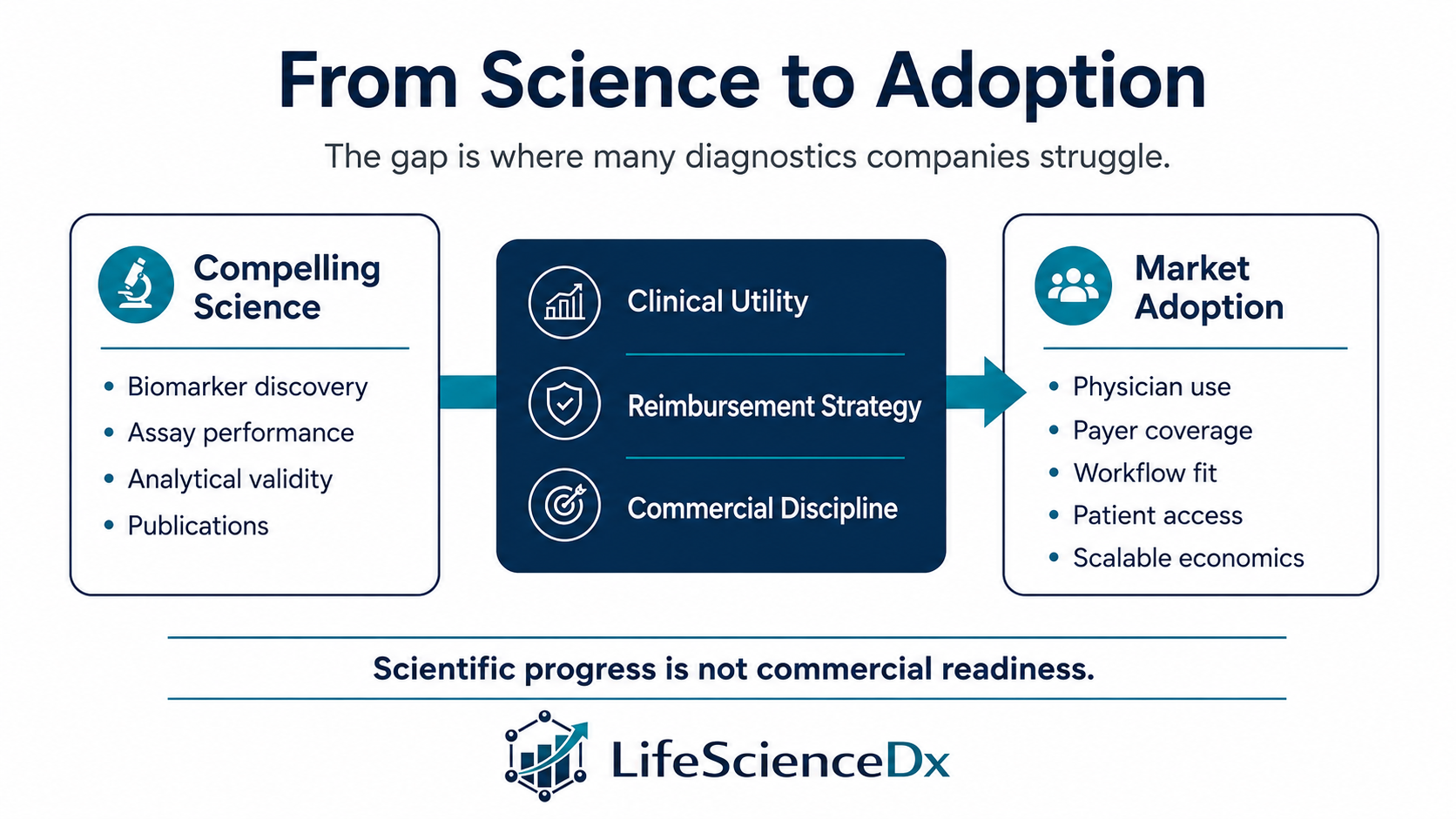
The path from validated science to commercial adoption requires deliberate strategy at every stage.
Where the Gap Opens
The commercialization gap usually becomes visible near launch, but it often opens much earlier.
It opens when companies generate evidence for scientific or regulatory progress without fully defining how the test will be adopted, paid for, operationalized, and scaled.
Several patterns appear repeatedly.
- The customer is not clearly defined. A diagnostic may involve the ordering physician, laboratory director, health system, payer, patient, biopharma partner, or investor. If the primary customer and decision-maker are unclear, the value proposition becomes diluted.
- Reimbursement is treated as a downstream activity. Coverage, coding, and payment strategy are often initiated too late — after the company has already built a commercial model around the assumption that reimbursement will follow.
- Workflow integration is underestimated. A test that adds burden to ordering, sample handling, reporting, interpretation, billing, or follow-up may face adoption resistance even when the clinical value is real.
- Evidence is generated for publication, not adoption or coverage. Clinical studies may support scientific credibility, but payer and physician adoption often require evidence that the test changes what happens next.
- Commercial execution is confused with commercial activity. Hiring salespeople, attending conferences, and creating awareness are not the same as building a repeatable commercial system.
Three Evidence Layers — Guided by Commercial Strategy
Diagnostics commercialization is best understood through three related but distinct evidence layers:
- Scientific Validation — Does the biology work?
- Clinical Validation — Does the test perform in the intended clinical population?
- Clinical Utility — Does using the test improve clinical decision-making, workflow, patient management, outcomes, or healthcare economics?
These layers are related, but they should not be blurred together.
Scientific validation creates credibility. Clinical validation creates confidence. Clinical utility creates relevance.
Clinical utility is especially important because it connects the test to real-world decision-making. It helps explain why a physician should order the test, why a payer should consider covering it, and why a health system, laboratory, or partner should support adoption.
Commercial strategy is not a fourth step after validation. It is the organizing discipline that helps determine which evidence is worth generating in the first place.
"Commercial strategy is not a fourth step after validation. It is the organizing discipline that helps determine which evidence is worth generating."
.png)
Successful diagnostics commercialization requires these evidence layers to connect with clinical, economic, and workflow realities.
Regulatory Progress Does Not Guarantee Market Access
Regulatory clearance or approval may enable market entry. It does not guarantee reimbursement, adoption, or scale.
Reimbursement asks a different set of questions:
- Is there an appropriate coding pathway?
- Is there payer coverage?
- What evidence does the payer require?
- Is the payment level sufficient to support the model?
- Will physicians have confidence ordering it?
- Will patient financial exposure create adoption risk?
Similarly, having a CPT code does not automatically solve market access. A code may create a billing pathway, but coverage, payment level, payer policy, utilization limits, and coding edits can still determine whether the business model is viable.
"In diagnostics, you can live and die by CPT codes."
Adoption Requires More Than Belief in the Science
A physician may believe the science and still hesitate to order the test.
If ordering creates workflow burden, reimbursement uncertainty, patient billing risk, or unclear clinical actionability, adoption may stall. In diagnostics, the full adoption experience matters: ordering, sample handling, reporting, interpretation, billing, follow-up, and the clarity of the clinical decision supported by the result.
This is why the test has to fit the way physicians, laboratories, and health systems actually work.
Commercialization Requires Operating Discipline
Even when the clinical and reimbursement strategy is sound, diagnostics companies still need commercial discipline to scale.
Commercialization is not simply hiring salespeople, building a website, attending conferences, or asking physicians to try a test. It requires clear customer segmentation, focused resource allocation, repeatable processes, field execution discipline, and metrics that inform action.
Commercial scale does not come from activity alone. It comes from building a system that can learn, repeat, and improve.
Companies that do this well test assumptions, measure outcomes, amplify what works, and stop what does not. Companies that do not build this discipline often confuse motion with progress.
From Scientific Innovation to Market Impact
Great science matters. In diagnostics, it is the foundation. But it is not the whole business.
To create scalable value, diagnostics companies must connect scientific validation to clinical validation, clinical utility, reimbursement strategy, physician adoption, workflow integration, operational execution, and sustainable economics.
The companies most likely to succeed are those that start with the end in mind — designing not only for technical performance, but for real-world adoption, payer value, workflow fit, and commercial viability.
Scientific innovation creates possibility.
Commercialization strategy determines whether that possibility reaches patients at scale.
At Life Science Dx, this is the type of commercialization architecture we help diagnostics and life science companies think through early — before avoidable complexity becomes a barrier to adoption, reimbursement, or growth.
Perspective Paper
Request the Full Perspective Paper
The expanded Life Science Dx perspective paper explores clinical utility, regulatory versus reimbursement strategy, CPT coding risk, physician adoption, workflow integration, commercial discipline, and the organizational decisions that determine whether promising diagnostics reach the market.
Let's Talk
Is your company facing a commercialization gap?
Life Science Dx works with diagnostics and life science companies to build the commercial strategy, evidence plan, and go-to-market model needed to close the gap between innovation and adoption.