
Insights & Perspectives
Regulatory Clearance Is Not Reimbursement
Regulatory clearance may allow a diagnostic test to enter the market. Reimbursement determines whether adoption can expand in a commercially sustainable way.

Regulatory clearance may allow market entry. Reimbursement determines whether a diagnostic test can be adopted, paid for, and used in a commercially sustainable way.
Regulatory progress is an important milestone for any diagnostics company.
It can create credibility, support market entry, provide a clearer product claim, and help customers, investors, and partners understand that the company has advanced beyond technical development.
But regulatory clearance is not reimbursement.
That distinction matters because many diagnostics companies build commercial plans around an assumption that regulatory progress will naturally lead to coverage, payment, and adoption.
It often does not.
Regulatory strategy and reimbursement strategy are related, but they answer different questions.
Regulatory review asks whether a diagnostic product can be marketed under a specific pathway and claim set. Reimbursement asks whether the healthcare system will pay for the test, under what conditions, at what level, and based on what evidence.
A diagnostic test can be scientifically credible, clinically validated, and regulatorily cleared, yet still face major barriers to coverage, payment, physician adoption, customer adoption, and commercial scale.
That is not a scientific failure.
It is a commercialization issue.
Market Entry Is Not Market Access
Regulatory clearance can enable market entry.
Market access requires more.
For a diagnostic test to become commercially viable — whether offered through a CLIA laboratory, sold as a kit or platform, or commercialized through a partner — companies need to understand the reimbursement pathway early:
- Is there an appropriate coding pathway?
- Does an existing code apply, or is a new code needed?
- What evidence will payers require?
- Is there a coverage pathway?
- What payment level supports the business model?
- How will denied claims be handled?
- How will patient financial responsibility be managed?
- Will physicians or customers have confidence adopting the test?
- Can the company support adoption while reimbursement is still developing?
These questions should not be treated as late-stage launch details.
They should influence evidence generation, clinical utility planning, commercial model design, laboratory strategy, sales deployment, partnership strategy, pricing, and investor expectations.
The Six-Step Pathway
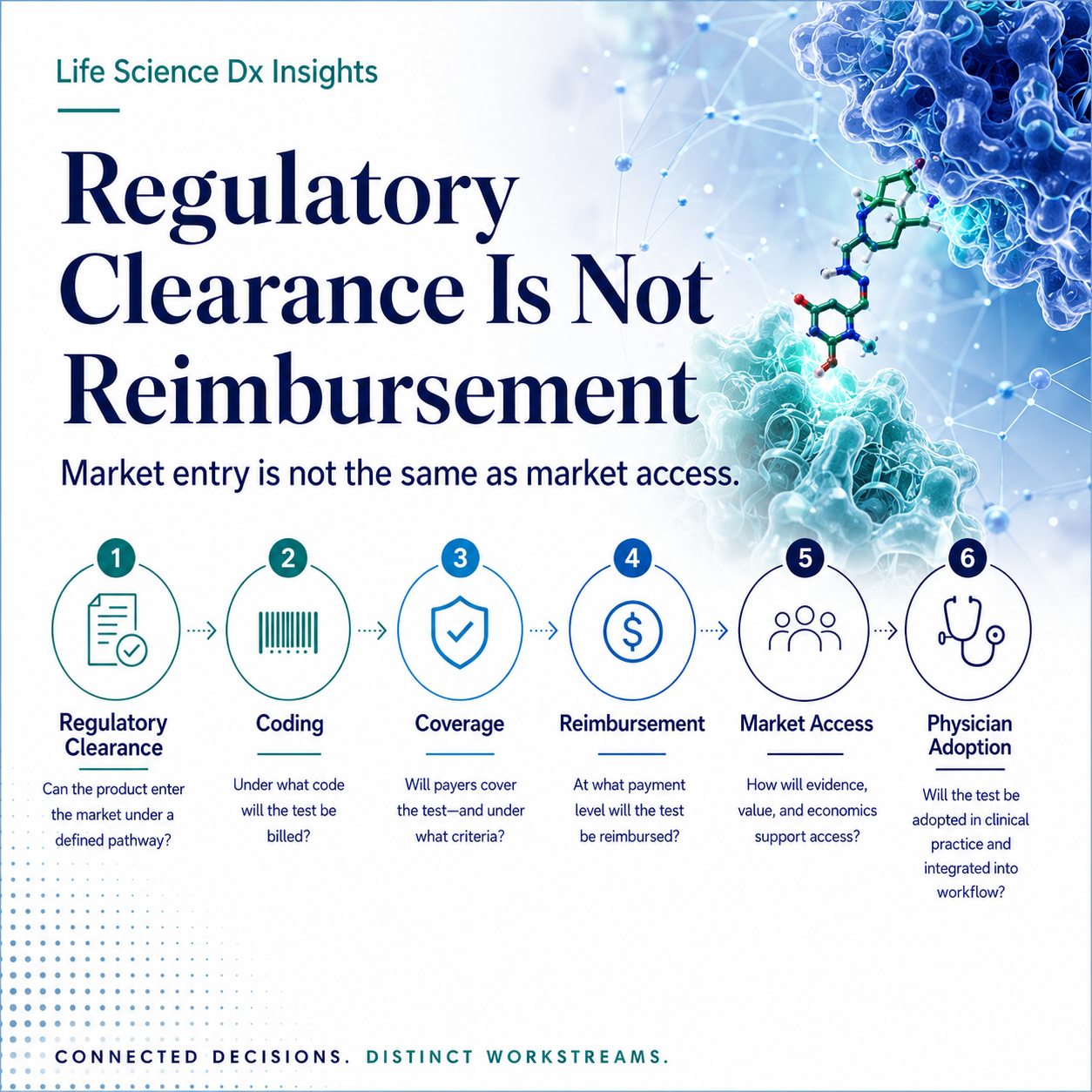
Regulatory clearance is step one of six. Each workstream answers a distinct question — and each must be addressed for a diagnostic test to achieve sustainable commercial adoption.
- 1Regulatory pathway
- 2Coding pathway
- 3Coverage strategy
- 4Payment model
- 5Physician and workflow adoption
- 6Commercial execution and scale
The Reimbursement Question Is Different
Regulatory clearance may support the claim that a product can be marketed.
Reimbursement asks whether the test creates enough clinical and economic value to justify payment.
That usually requires more than analytical performance.
Payers want to understand whether the test changes what happens next. Does it influence diagnosis, therapy selection, monitoring, referral, risk stratification, patient management, or downstream cost?
A test that performs well but does not clearly support a clinical decision may struggle to secure coverage. A test that supports a clear clinical decision has a stronger reimbursement argument.
This is why clinical utility and reimbursement strategy need to be connected.
Clinical utility helps explain why the test matters in care. Reimbursement strategy translates that value into a coverage and payment pathway.
"A code is not the same as coverage. And coverage is not the same as adequate payment."
Coding Is Necessary, But Not Sufficient
A coding pathway is vital. Without an appropriate CPT, PLA, HCPCS, or other recognized procedure code, billing public or private payers becomes difficult, reimbursement becomes uncertain, and patients may become financially responsible for the cost of the test.
But a code is not the same as coverage.
And coverage is not the same as adequate payment.
Diagnostics companies sometimes identify an existing code and assume that the reimbursement problem is largely solved. In some cases, an existing code may support early billing and market entry. That can be a reasonable strategy.
But it can also create risk if the business model depends on assumptions that are not durable.
Payment levels can change. Payer policies can tighten. Utilization controls can appear. Coding edits can affect claims. Coverage requirements can become more specific. A code that appears workable at launch may not support a scalable commercial model over time.
That does not mean companies should avoid existing codes.
It means they need to understand the risk, model the downside, and build a longer-term reimbursement strategy before the market forces them to react.
Reimbursement Affects Adoption
Reimbursement is not only a payer issue. It is also an adoption issue.
A physician may believe the science and understand the clinical value of a diagnostic test, but still hesitate to order it if reimbursement is uncertain or if the patient may receive an unexpected bill.
A laboratory, health system, diagnostics company, or commercial partner may also hesitate to adopt a test, platform, or kit if the reimbursement path does not support the economics of acquisition, implementation, sales, and ongoing use.
That matters because reimbursement often shapes the business case for the customer.
In a CLIA laboratory or LDT model, reimbursement affects launch timing, payer engagement, physician adoption, patient financial responsibility, revenue forecasting, and cash planning.
In a kit, platform, assay, or licensing model, reimbursement is just as important. The purchasing or commercialization partner still needs to understand how the test will be billed, what payment may be available, what coverage requirements apply, and whether the expected reimbursement can support the economics of acquiring, distributing, or adopting the technology.
For the upstream vendor, reimbursement may not be collected directly. But it still affects pricing, customer willingness to buy, partnership value, royalty potential, sales cycle, and the business case presented to the customer's CFO or executive team.
If the ordering process is unclear, if coverage is unpredictable, or if patient financial responsibility is poorly managed, the physician may decide that the test creates more practical difficulty than clinical value.
If the customer cannot build a credible reimbursement-based business case, the test may face adoption barriers even when the underlying technology is strong.
A reimbursement strategy that does not account for physician, patient, customer, and partner experience is incomplete.
Commercial Plans Should Reflect Reimbursement Reality
A diagnostic company's commercial model should be built around realistic reimbursement assumptions.
This affects:
- launch timing
- pricing strategy
- evidence investment
- payer engagement
- physician targeting
- customer targeting
- field team messaging
- laboratory partnerships
- partner economics
- revenue forecasting
- customer ROI
- cash planning
- investor communication
If reimbursement is uncertain, the company may still proceed, but the commercial plan should reflect that uncertainty.
A company may need a phased launch, targeted customer segments, a specific payer evidence plan, a cash-pay or institutional model, a laboratory partner strategy, a licensing model, or a narrower use case that better supports coverage and payment.
The problem is not uncertainty itself.
The problem is building a commercial plan as if reimbursement uncertainty does not exist.
Start Reimbursement Planning Earlier
The strongest diagnostics companies begin reimbursement planning early, while there is still time to shape the evidence plan, intended-use population, clinical utility argument, coding pathway, and commercial model.
That does not mean every reimbursement question can be solved early.
It means the company should know which questions matter, what evidence may be required, what assumptions carry risk, and what milestones should determine whether the program advances, changes, partners, pauses, or stops.
For diagnostics companies, reimbursement planning is not an administrative step.
It is part of commercial strategy.
The Commercialization Lesson
Regulatory clearance can be a meaningful achievement.
- But it does not guarantee coverage.
- It does not guarantee payment.
- It does not guarantee physician adoption.
- It does not guarantee customer adoption.
- It does not guarantee commercial scale.
Diagnostics companies need to build regulatory strategy and reimbursement strategy as connected but distinct workstreams.
The more useful question is not only:
Can we get the test to market?
The stronger commercial question is:
Can we get the test adopted, paid for, and used in a commercially sustainable way?
That is why regulatory clearance is not reimbursement.
And it is why reimbursement strategy needs to begin before launch.
Life Science Dx Consulting helps diagnostics companies connect regulatory progress, clinical utility, reimbursement strategy, customer adoption, and commercial execution into a practical path to market.
Let's Talk
Continue the Discussion
Life Science Dx works with diagnostics and life science companies to build the reimbursement strategy, clinical utility evidence, and commercial execution model needed to move from regulatory clearance to sustainable adoption.