
Life Science Dx Insights
Workflow Integration: The Missing Discipline in Diagnostic Commercialization
Diagnostic adoption depends on more than science, evidence, regulation, or reimbursement. It depends on whether the patient, physician, operational, laboratory, reimbursement, reporting, and commercial workflows can work together in routine care.
Scientific credibility matters. Clinical validation matters. Regulatory status matters. Reimbursement matters. But in diagnostics, credibility is only the starting point.
A diagnostic product succeeds only when it can move through the actual workflows of patients, physicians, laboratories, payers, health systems, and commercial teams. The test has to be understood, ordered, collected, processed, reported, interpreted, paid for, and acted upon. Increasingly, that also means the test must fit into the electronic systems clinicians already use for ordering, documentation, result review, and patient management.
This is where many diagnostic commercialization plans begin to break down.
A company may have compelling science, a strong technical platform, promising data, and even regulatory clarity or clearance, but if the workflow is not understood and supported, the product can still struggle to gain traction.
This is where strategic workflow mapping becomes valuable.
A Diagnostic Test Moves Through Multiple Workflows
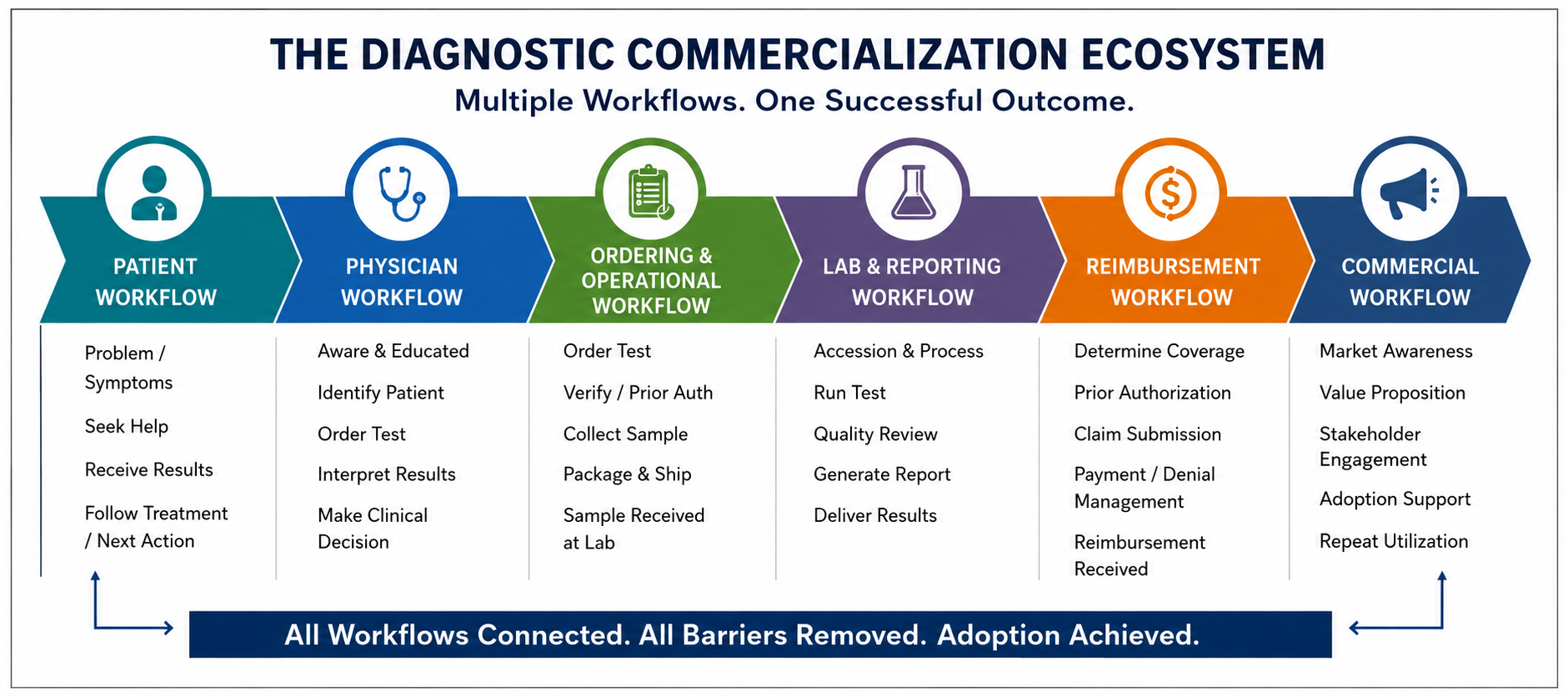
A diagnostic test does not enter the market as a single product claim. It enters the market through a series of connected workflows.
Patient, physician, ordering, sample collection, laboratory, reporting, reimbursement, and commercial workflows all shape whether the test is adopted. These workflows have to work together.
Looking at the same test from each stakeholder's perspective reveals why adoption barriers often appear in different places.
From the patient's perspective, the process often begins with a problem. The patient experiences symptoms, seeks medical help, sees a physician, receives a diagnostic recommendation, completes a collection process, navigates cost or insurance questions, receives a result, and then takes action based on medical advice.
From the physician's perspective, the workflow is different. The physician has to understand the clinical context, recognize the right patient, believe the test is useful, know how to order it, explain it to the patient, receive the result, interpret the report, and use the information to make or refine a clinical decision.
From the company's perspective, there is another workflow. The company has to create awareness, educate the market, position the test appropriately, support ordering, address reimbursement, manage sample logistics, deliver reports, support billing, train customers, and reinforce repeat utilization.
These workflows are connected, but they are not the same. A company that only understands one of them may miss the real adoption barriers.
That distinction is why workflow fit must be treated as a commercial requirement, not an operational detail.
Workflow Fit Is a Commercial Requirement
A diagnostic test may be scientifically credible and still fail to fit the physician's workflow.
- If ordering is difficult, adoption suffers.
- If sample collection is confusing, completion rates suffer.
- If reimbursement is unclear, physician and patient confidence suffer.
- If the report is hard to interpret, clinical utility suffers.
- If the result does not connect to a decision, repeat utilization suffers.
EHR integration is an important part of workflow fit. For many diagnostic products, adoption depends on whether the test can be ordered through a practical clinical pathway and whether results can return through the physician's normal reporting, documentation, and patient-management environment.
A separate portal, fax, paper requisition, disconnected PDF, or manual process may work in limited settings, but it can become a barrier to scale. Ordering and result reporting should be evaluated as part of the same workflow because both determine whether the test can be used repeatedly in routine care.
Each step matters because each step represents a potential point where adoption can slow, stall, or fail.
This is especially important for emerging diagnostic companies and smaller CLIA laboratories. Large reference laboratories often have established collection infrastructure, patient service centers, courier networks, laboratory interfaces, billing systems, and customer support models. Emerging companies often have to build, partner for, or deliberately design these capabilities.
That does not mean smaller companies cannot succeed. It means the workflow requirements need to be mapped and designed intentionally.
A diagnostic company cannot assume that physicians, patients, office staff, laboratories, or payers will absorb operational complexity simply because the test is clinically interesting.
"Workflow fit must be treated as a commercial requirement, not an operational detail."
Reimbursement Is Also a Workflow
Reimbursement is often discussed as a payer issue. But in diagnostics, reimbursement is also a workflow issue.
- If a test requires prior authorization, that requirement affects ordering.
- If the patient may receive a bill, that affects consent and collection.
- If coding is unclear, that affects billing.
- If coverage is inconsistent, that affects physician confidence.
- If documentation is required, that affects office workflow.
- If denials and appeals are common, that affects company infrastructure.
Payment is not separate from adoption. It is embedded in the workflow.
A reimbursement strategy that does not account for workflow can create barriers at the exact point where adoption should be happening.
Commercial Activity Should Connect to Workflow Adoption
The commercial workflow is not simply sales and marketing activity. It is how the company builds market understanding, stakeholder confidence, operational readiness, and repeat utilization.
Every commercial asset should connect to a real point in the workflow.
- A brochure should do more than describe the product. It should help a stakeholder understand where the test fits and why it matters.
- A sales presentation should do more than list features. It should help the physician, laboratory, hospital, payer, or administrator see how the test changes a decision, solves a problem, or reduces burden.
- A reimbursement document should do more than describe coverage strategy. It should support the practical steps required to get the test paid for.
- A training tool should do more than educate. It should reduce barriers in ordering, collection, interpretation, or follow-up.
Commercial activity is most effective when it helps remove a specific workflow barrier or supports a defined step in adoption.
Workflow Maps as a Prioritization Tool
The broader strategic value of workflow mapping is that it turns a complex adoption pathway into a practical prioritization tool.
Once the patient, physician, operational, laboratory, reimbursement, reporting, and commercial workflows are visible, every initiative can be evaluated against a practical question:
Where does this improve the path to adoption?
Does the initiative make the test easier to order, collect, process, report, interpret, pay for, explain, act on, or use again? If yes, it may deserve priority. If no, the company should question whether it belongs near the top of the list.
This is especially important for emerging companies, where capital, time, leadership attention, and market credibility are limited.
- Not every project is equally important.
- Not every feature matters.
- Not every marketing asset moves adoption.
- Not every operational investment should be funded first.
- Not every internal activity represents market progress.
The workflow map helps distinguish activity from progress. Activity is effort. Progress is effort that removes barriers between clinical need, test order, sample collection, result delivery, reimbursement, and patient management.
"The workflow map helps distinguish activity from progress."
Commercial Readiness Requires Workflow Integration
Diagnostics are not simply tests. They are clinical decision tools that have to move through a complex healthcare environment before they can influence patient care.
A diagnostic product may work scientifically and still struggle commercially if the workflow required to use it has not been designed.
- The test may be clinically valid, but difficult to order.
- It may answer an important question, but require a collection process that is not practical.
- It may generate useful data, but return a report that is not easy to interpret.
- It may support a clinical decision, but lack a clear reimbursement pathway.
- It may gain early adoption, but fail to support repeat utilization.
Each of these issues represents a different form of commercialization risk. Strategic workflow mapping helps make those risks visible before they become market problems.
A diagnostic product is not commercially ready simply because it works. It is commercially ready when the workflow required to order it, collect it, process it, report it, interpret it, pay for it, and act on it has been mapped, stress-tested, and supported.
For emerging diagnostic companies, workflow mapping should be treated as a commercialization discipline — not a post-launch troubleshooting exercise.
Full Insight Paper
Request the Full Insight Paper
Strategic workflow mapping can help diagnostic companies identify where adoption will succeed, stall, or fail before launch. The full Life Science Dx paper expands this framework across patient, physician, operational, laboratory, reimbursement, reporting, commercial, product development, and messaging workflows.
Let's Talk
Is your company working through workflow integration challenges?
Life Science Dx works with diagnostics, precision medicine, and life science companies to evaluate commercialization strategy, workflow integration, reimbursement, market access, adoption, and growth execution.